Showing posts with label education philosophy for preschool. Show all posts

Friday, June 15, 2012

a Waldorf morning

good morning dear earth
good morning dear sun
good morning dear trees and flowers every one
good morning dear beasts and birds in the tree
good morning to you and good morning to me


-source unknown

I spent a beautiful morning with Marieka, a homeschooling mom who uses the Waldorf philosophy for education.  She has three children, the oldest is 5 and she is in "Kindergarten", the middle is 3 and youngest is a year and a half.  The younger children participate in the morning as well and Waldorf is such a gentle approach with singing, rhymes and storytelling that it is natural for young children to enjoy "school" without having to keep busy while the older child does school with mom.  I love that!

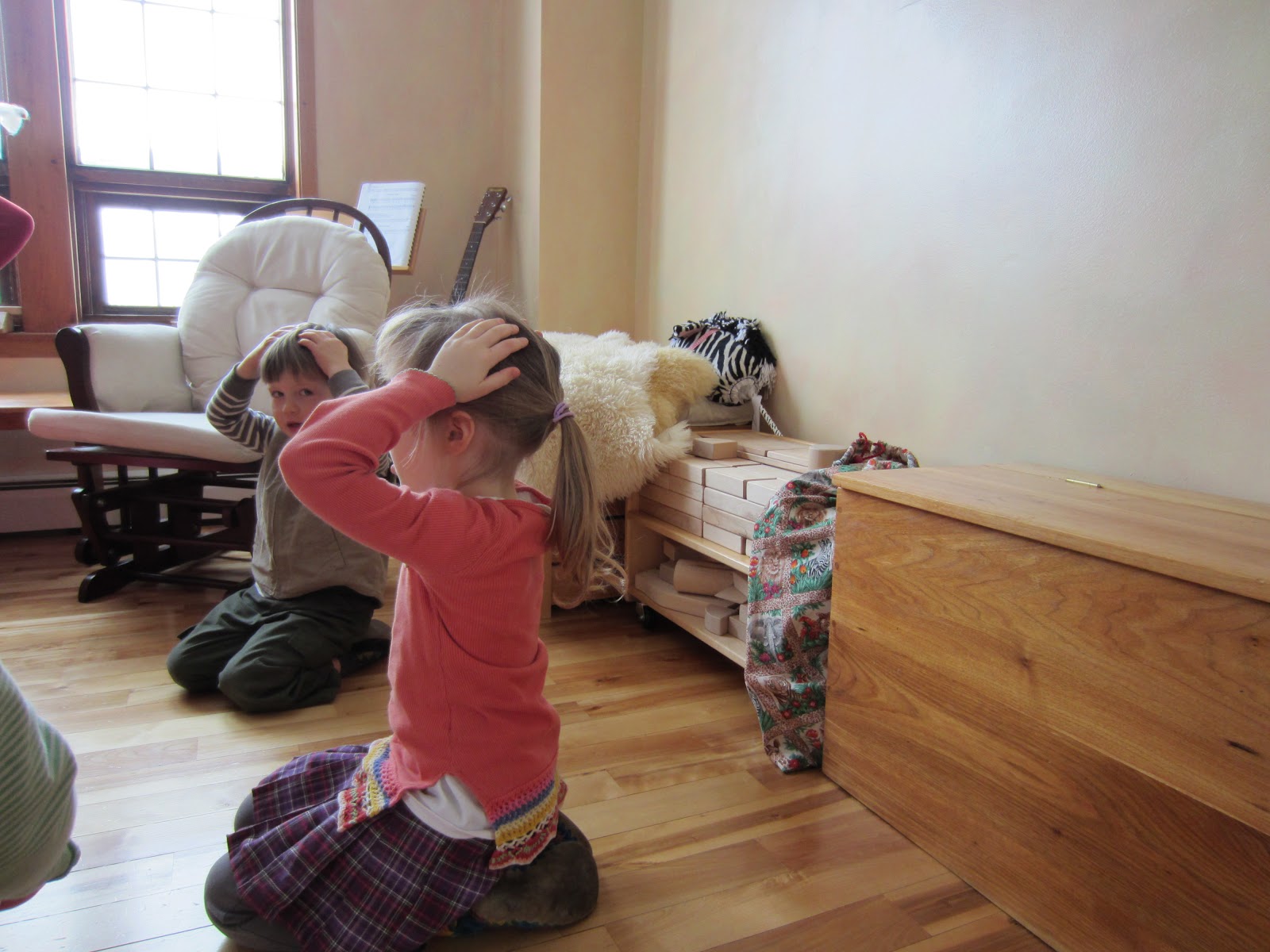
We arrived to their rural homestead around 10 am and were welcomed in. A candle was lit in the room to indicate the beginning of our morning together.  We started the morning with the good morning verse written above and each child was welcomed individually using their name.  The morning continued with beautiful songs (one with guitar accompaniment), rhymes and action songs.  Marieka moved through the songs seamlessly without introducing them and everything was memorized on her part.  The children (and I) followed when we could and enjoyed the calm flow of the morning.


The setting for the morning songs and rhymes was a central room in their house, painted a light pastel with wood and natural fibers/cloth used for toys and storage. Waldorf education is an educational system based on a child's development.  Waldorf education believes in the education of the whole child, encompassing the head, heart and hands. The rhythm of the day is emphasized in their home with even the songs and rhymes and stories repeated for a couple of weeks.


Let's put on our coats and zip them all the way
It is very cold on the wintry day
Next comes boots, mittens and hat
Now we are ready, just like that
But it is so cold, let's get warm by moving about

Clap your hands, spin around, jump in and jump out!
Now we are read to take a journey,
To find King Winter's castle, follow me.

"Wynstones" by Nancy Foster


We had the icy tunnel, two frozen rivers and frozen log to cross over and the children enjoyed this active rhyme very much.


We moved to the kitchen for the storytelling.  A candle was lit at the large dining room table and the children sat quietly, listening to Marieka and her story of the little duck and his search for fish through the ice.


We had a yummy snack of popcorn popped on the stove (coated with butter and nutritional yeast... a new favorite around here!) and I seized the opportunity to ask Marieka a few questions about her experiences with Waldorf and why she chooses this method for her family. She discovered Waldorf through a relative who homeschooled using this philosophy and then in Ontario, took training at the Waldorf training program in Toronto. She had one year of preparatory studies in anthroposophpy, which is the philosophy founded by Rudolf Steiner.  This philosophy is the foundation of Waldorf education, and the first Waldorf school opened in 1919 in Germany.

Marieka's second year of training focused on 4 practicums.  As a student teacher, she focused on carving, dance and clay.  Marieka also worked at The South Shore Waldorf School for a year and a half.  She is a strong believer in the importance of being a teacher for your children in the early years, and is passionate about educating the whole child. Waldorf reflects what might have traditionally happened at home with young  children, following rhythms of the day and with no traditional academics in the early years.  Marieka may not have always known she would stay at home and homeschool but it seems natural and beautiful the way the children respond to this type of learning in her home.

Outdoor life is another very important aspect of Waldorf education.  In fact, some schools take place entirely outdoors.  Every day, after snack, Marieka and her children head outside.  I happened to be there on a beautiful sunny day, with a fresh snowfall from the night before.  Charlotte could have stayed out all afternoon!


Thank you, Marieka for letting me participate in a memorable homeschooling morning. We truly enjoyed this experience and appreciate the peek into your Waldorf homeschool!

Tuesday, October 25, 2011

Montessori and the Prepared Environment

It has been ages since I started writing about preschool philosophies and trying to come to a decision about what philosophy to take as I embark on teaching Charlotte at home. Since that time I have done a lot of reading, but not much writing, struggling to find a balance between being a mama and wife, and creating time for "me" to write about everything I have been learning.

I have already written about Reggio Emilia and Classical Education , and today I will focus on Montessori Education. A remarkable woman named Maria Montessori (1870-1952) founded Montessori education. She was the first female to receive a medical degree in Italy. It 1907 she took care of fifty poor children in a slum outside of Rome. She became known for her success in the Casa dei Bambini (House of Children) and her methods of education spread across the globe. According the montessori.edu,

"She believed that each child is born with a unique potential to be revealed, rather than as a "blank slate" waiting to be written upon. Her main contributions to the work of those of us raising and educating children are in these areas:
  • Preparing the most natural and life-supporting environments for the child
  • Observing the child living freely in this environment
  • Continually adapting the environment in order that the child may fulfill his or her greatest potential, physically, mentally, emotionally, and spiritually."


    There are many, many resources on the web for Montessori education. There is also a local Montessori school in this city, however the wait list is three years for their preschool program! I love reading blogs that base their philosophy upon Montessori education, like Chasing Cheerios. The thing is, the more I read about Montessori, the more I feel under prepared, and not qualified to teach with this philosophy in mind. There are schools to train Montessori teachers and in order to teach at a Montessori school, I believe you have to be trained.

    So how do I implement Montessori in our home environment? I am trying to get a handle on our space, the environment which we work, which is our home. It is a difficult task, and I can not really implement a lot of the specific Montessori toys and tools, as it would cost a lot, as well as take up a lot of space. I picture wooden toys, carefully chosen decorations, things like tongs for sorting small objects, and a shelf of specific activities separated in baskets ready for the child to choose and play on their individual mat. Of course, this is my own perspective, and may not be true to Maria Montessori's vision. Maria Montessori also created tables and chairs and other furniture to fit the child. We have a small table and chair set that my sister refurbished as a gift for the girls. It is lovely! Other than that, I keep Montessori's ideals in my head regarding a beautiful space and I try to observe Charlotte in her play rather than have it "teacher directed" all of the time.

    Another aspect of Montessori philosophy is involvement in every day life: family care, self care and care for the environment. I have been attempting to incorporate Charlotte into more of our daily tasks, which also increases her sense of significance in our family. This includes dressing herself, helping with outdoor chores and indoor chores including raking, sweeping, washing breakfast dishes and cleaning up spills with my vinegar and water solution. She does not do all of these every day, but when she is able to contribute in a practical way, she loves doing it, and always feels a sense of accomplishment and happiness through doing a practical task. It helps me change my perspective a bit about housework! (Although tasks usually take longer of course.)


    What is your experience with Montessori education?
    How do you incorporate a Montessori philosophy into your parenting and/or homeschooling?

Saturday, July 30, 2011

A Taste of Classical Education

I can't quite remember where I first heard of Classical Education, but I didn't even include it on my list of philosophies for preschool. I was skeptical of what I assumed was a super structured approach, focused on bookwork and lots of worksheets. I was inspired by the Curriculum Fair on Simple Homeschool and Tsh's article on Classical Curriculum for a Flexible Lifestyle. I did some exploring online and went to our local library website to find "The Well Trained Mind" by Susan Wise Bauer and Jessie Wise. I placed it on hold, along with "The Well Educated Mind" by Susan Wise Bauer.

As I started reading, I was constantly arguing the points in my mind, wondering if there really was something to their philosophy of learning and that the first few grades of school are the appropriate time for practice work and memorization as this is the first stage in the trivium.

Let me back up here. The Classical philosophy focuses on three stages of learning called the trivium. The first is called the "grammar stage" as this is when the building blocks for learning take place. They consider this stage as happening in grades 1 to 4. The mind is ready to absorb information and children find memorization fun. (Charlotte is already repeating poems and sections of books that she has memorizes and uses them in her play!) The learning of facts plays an important part here. This includes phonics, spelling, rules of grammar, vocabulary of foreign languages, facts of mathematics, the stories of literature and history, descriptions of plants and animals and the list goes on and on. The focus is not on self-discovery or self-expression.

The second stage is is the "logic stage" during the middle school years. During these years, students focus on cause and effect, relationships between different fields of knowledge and the way that facts fit together. Abstract thought begins to mature at this age.

The third stage is called the "rhetoric stage" in which the high school student uses all of the knowledge they have built up to write and speak with originality. Students begin to specialize in their areas of interest at this point.

Classical education is print focused and not image or video focused. In other words, phonics and letters are not learned by watching animated alphabet letters jump and dance on the screen.

There is also a systematic way of organizing the information that is learned according to time periods in history. Knowledge is interrelated and one topic is not to be studied in isolation.

The Well Trained Mind website has piles of information and I have read a few of the articles under "getting started" and FAQ.

I have become very interested in this type of education. Although I would not follow "The Well Trained Mind" to the letter (the book is a curriculum for grade 1-12), I think it has some very interesting ideas in it's philosophy that I would not have previously considered. In my education degree, we were taught that project-based learning and thematic learning were the way of the future in education. The truth is, educational trends are always coming and going. I do not think there is anything wrong with projects, especially projects that students are interested in, however I DO think that a structure is key for education. A structure that builds on itself, and focuses on the teaching of skills so that students can use these skills without having to completely concentrate on the skill itself. For example, the student who struggles sounding out words and does not know the sounds for consonants and vowels will struggle to read until they have mastered the basic skills for reading. The same could be said of a skill like sewing. If I have not mastered sewing a straight line and how to thread my machine every time that I try to sew will be a frustrating project. I need to practice some basic skills before I can sew a skirt! (Which is the truth!)

As for preschool education? There is not much written about it in this book. They mention one resource book and discuss the importance of talking to your kids and reading with your kids. There is also a book about teaching your kids to read. I think that this is purposeful in that they don't intend for your three year olds to be sitting for an hour of bookwork and phonics skills!

I feel a bit of the pressure lifting for preschool education after reading this book and articles on the website. I feel like a focus on reading and making the sounds for letters is sufficient at this point. I am challenged and intrigued by this philosophy that originated in the Middle Ages, and I'm looking forward to studying it further if we do decide to homeschool.

Tuesday, May 17, 2011

Reggio Emilia Approach

"...a hundred worlds to discover
a hundred worlds to invent
a hundred worlds to dream."
Loris Malaguzzi, founder of the Reggio Emilia Method


I first heard of Reggio Emilia in my Play class doing my degree in Education at UNB. I was fascinated at once and seemed inwardly drawn to this philosophy of education. The founder of this approach, Loris Malaguizzi saw a need for preschool education after World War II in Italy. The town in Italy where the school began is called Reggio Emilia and the focus is on primary education. The need arose out of the destruction from the war and the desire of the parents and community to teach their children respect and responsibility through self-guided curriculum.

Exploration, discovery and creativity are key elements to this approach.


A few of the underlying principle of the Reggio Emilia approach are:

  • The child is a collaborator, communicator and plays a central role.
  • The teacher is a partner to the child, a nurturer, a researcher and a guide.
  • Cooperation and community involvement are foundational.
  • The environment is considered the "third teacher" (this includes the physical classroom space).
  • The parent is considered a partner in the educational process.
  • Documentation is of utmost importance, for communication and learning.


Aspects that I love about Reggio Emilia:
  • The emergent curriculum. The curriculum is built upon the child's interests. Topics of interest come up from observing and documenting the children's conversations or from their known interests. The curriculum often involves large projects that start with a certain topic and build and grow to in-depth studies of that topic.
  • The creative aspect. Art in many forms is important, and considered the symbolic representation of children. Art is the child's language.
  • The role of the teacher as collaborator. The teacher works alongside the child not solely as an instructor, but as an facilitator. Collecting data and documenting using writing, recording devices help the teacher learn and assess.


Difficulties with the Reggio Emilia approach:

  • The philosophy is rooted in Italian culture and community and not meant to be duplicated (I don't think) fully in a American/Canadian setting. The philosophy must be adapted to our own community and culture without losing it's main tenants.
  • For the homeschooling family, Reggio Emilia poses difficulty because of the focus on collaboration and groups of children working together. A multi-age homeschool co-op would probably be the best form for implementation.


If you would like to read more on Reggio Emilia, consider these resources:
Official Reggio Emilia website
Reggio Emilia on Wikipedia
Reggio Emilia on the Homeschool Learning Network
Camp Creek Blog (homeschooling with a Reggio approach)
Wee Can Too (a local program inspired by Reggio)

Monday, February 28, 2011

Introduction to Education Philosophy for Preschool

Charlotte is nearing preschool age and my head has been spinning lately with ideas to implement a semi-structured program for her in the fall. Many of my friends are looking into three year old programs, but I think we are going to stay close to home for our preschool (3 and 4 year old) education. I have also considered homeschooling, and although that will depend on a few different factors, I want to be prepared when it comes to considering philosophy, theory and practice. Purely out of interest's sake, I have ordered books on Montessori and Reggio Emilia from the library and hope to continue some research with Waldorf and Charlotte Mason.

I have discovered that this is actually a love of mine, researching and planning for preschool education. When I did my internship for elementary education I was placed in a Kindergarten class. I loved my "Play" course at university where we worked in the 4-year-old classroom observing and preparing an imaginative play center. I love this age group, I am fascinated by the capacity for learning through play and how to assess learning. Although I know that Charlotte is a tremendously social girl (and lack of social interaction is often a criticism against homeschooling families) we will be involved in many social activities throughout our weeks. In my opinion, I am already involved in the education process daily with both of my daughters and furthering this education at home seems like a natural progression for us. And it goes without saying... I am learning and growing every day as my girls teach me how to mother, love unconditionally and be stretched physically, mentally and emotionally.

As I began to read, I thought about compiling a summary of sorts for this blog and writing my thoughts regarding different philosophies of education, in particular, for preschool. I will review and consider the following:

1. Reggio Emilia
This is a child-centered approach developed over the last fifty years in Reggio Emilia, Italy. A few of the principles are: collaboration (parents, teachers, students, the larger community); the image of the child (as competent and inventive); and preparing an environment that acts as the third teacher.

2. Montessori
This approach was founded it 1907 and is based on the experiences of Maria Montessori, an Italian physician and educator. One of the underlying principles is that of a prepared environment where children choose individual activities to pursue and they teach themselves. Montessori also focuses on learning through all five senses and giving children responsibility through everyday life tasks.

3. Waldorf
This is a humanistic approach based on the research and philosophy of Rudolf Steiner. Steiner was an Austrian philosopher and who founded anthroposophy (a spiritual philosophy focused on a spiritual world accessible through inner development). The Waldorf approach focuses on the creative, the natural world, inner growth and moral responsibility. The first school was founded in 1919 in Germany.

4. Charlotte Mason
Charlotte Mason was a British educator who lived in the late 1800s and early 1900s. The method is centered around the idea that education has three aspects: an atmosphere, a discipline and a life. The method is known for promoting and using living books - stories that have one author, who has a passion for that subject, rather than textbooks.

I may add more as I discover new ideas and hopefully either decide on a philosophy to start with Charlotte, or combine ideas from various philosophies and come up with my own principles to guide our education experience for her third year.

What are your thoughts and ideas about homeschool, preschool or education theory and practice?